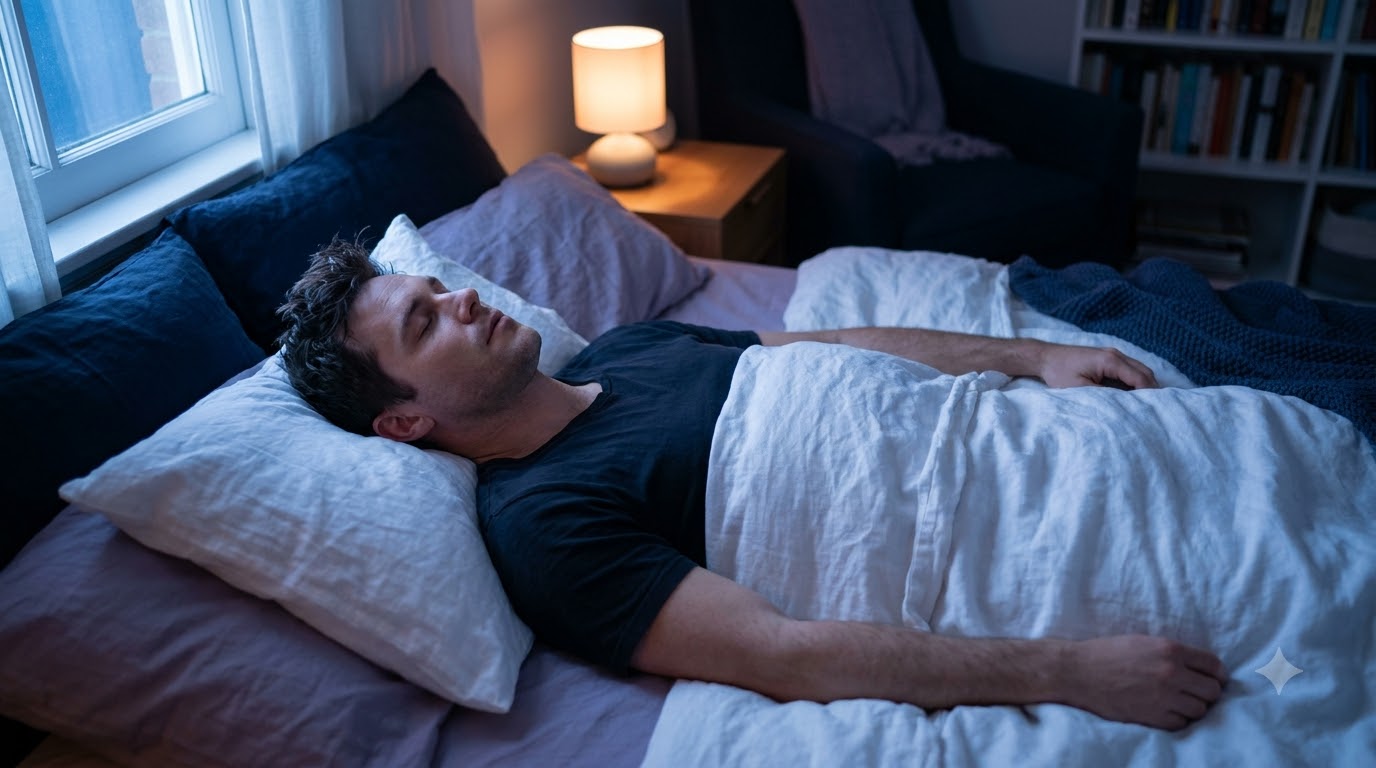
To fall asleep faster, relax your body and quiet your mind at the same time. The military method (relax your face, drop your shoulders and arms, breathe out, relax your legs, then picture a calm scene) is a good place to start. Slow breathing like 4-7-8, progressive muscle relaxation, and “cognitive shuffling” also work well. These skills get more effective with practice, so try one every night for a couple of weeks.
Lying in bed willing yourself to sleep rarely works. The harder you try, the more awake you feel. The trick is to stop trying to sleep and instead create the conditions where sleep happens on its own: a relaxed body and a calm, unfocused mind.
Here are seven techniques you can try tonight, starting with the one everyone asks about.
1. The military method
This technique is widely shared online as a method used to help people in the military fall asleep anywhere, even in noisy, uncomfortable conditions. There’s little formal research on this exact routine, but it combines two well-studied tools: muscle relaxation and calming mental imagery.
How to do it:
- Relax your face. Let your forehead, eyes, cheeks, jaw, and tongue go loose. Unclench your teeth.
- Drop your shoulders as low as they’ll go, then let your upper and lower arms go heavy, one side at a time.
- Breathe out slowly and let your chest relax.
- Relax your legs, starting with your thighs, then your calves, then your feet.
- Clear your mind for about 10 seconds by picturing a calm scene, such as lying in a canoe on a still lake or in a dark, cosy room. If thoughts keep coming, slowly repeat the words “don’t think, don’t think” in your head.
Don’t worry if it doesn’t work the first night. Like any relaxation skill, it tends to work better with regular practice.
2. 4-7-8 breathing
Slow breathing with a long exhale can help shift your body out of “alert mode” and into a calmer state.
- Breathe in quietly through your nose for a count of 4.
- Hold your breath for a count of 7.
- Breathe out slowly through your mouth for a count of 8.
- Repeat for four cycles to start.
If holding your breath feels uncomfortable, skip the hold and simply make your exhale longer than your inhale (for example, in for 4, out for 6). If you have a lung or heart condition, check with your doctor before trying breath-holding exercises.
3. Progressive muscle relaxation (PMR)
PMR teaches your body the difference between tension and relaxation. It’s often used as part of insomnia treatment.
- Start with your feet. Gently tense the muscles for about 5 seconds.
- Release and notice the feeling of relaxation for 10 to 15 seconds.
- Move up through your body: calves, thighs, stomach, hands, arms, shoulders, neck, and face.
Don’t tense so hard that it hurts. If you have an injury, skip that area.
4. Cognitive shuffling
If your mind races with worries and to-do lists, give it something boring and random to do instead. Pick a word like “BEDTIME.” For each letter, think of as many random, unrelated words as you can and picture each one briefly: B: banana, bicycle, balloon… E: elephant, envelope…
The randomness mimics the drifting, jumbled thoughts that happen naturally as you fall asleep, and it crowds out worrying.
5. Body scan
Lie still and slowly move your attention through your body from your toes to the top of your head. Simply notice each area without trying to change anything. When your mind wanders, gently bring it back. Many free meditation apps include guided body scans for sleep.
6. Paradoxical intention
This one sounds strange: lie in bed with your eyes open and gently try to stay awake. Don’t use your phone or get up, just rest comfortably and try not to fall asleep. For some people, removing the pressure to sleep reduces the anxiety that was keeping them awake.
7. Fix your setup
Even the best technique struggles against a bad environment. Check the basics:
- Cool: Keep your bedroom on the cool side.
- Dark: Use blackout curtains or a sleep mask.
- Quiet: Use earplugs, a fan, or a white noise machine.
- No clock-watching: Turn your clock away and keep your phone out of reach.
What to do if nothing works
If you’ve tried a technique and you’re still wide awake after what feels like 20 minutes, get up. Go to another room with dim light and do something calm, like reading a paper book or folding laundry. Return to bed when you feel sleepy. Staying in bed frustrated teaches your brain to associate your bed with being awake.
If it regularly takes you more than 30 minutes to fall asleep, or you have trouble sleeping three or more nights a week for several weeks, talk to a healthcare provider. Ongoing trouble falling asleep may be insomnia, and cognitive behavioral therapy for insomnia (CBT-I) is a recommended first treatment.
- Stop trying to force sleep — focus on relaxing your body and calming your mind.
- The military method combines muscle relaxation with calming imagery.
- 4-7-8 breathing, PMR, and cognitive shuffling are easy to try tonight.
- Practice one technique nightly for a couple of weeks; it gets easier.
- If you can’t sleep after about 20 minutes, get up and return when sleepy.
Frequently asked questions
Does the military method really work in 2 minutes?
Claims about falling asleep in exactly two minutes come from popular articles, not clinical studies. The relaxation steps in the method are well supported, though, and many people find that, with practice, they help them fall asleep faster.
How long should it take to fall asleep?
For most healthy adults, falling asleep within about 10 to 20 minutes is typical. Falling asleep instantly every night can actually be a sign you’re not getting enough sleep.
Is it OK to listen to something while falling asleep?
Yes, if it helps you relax. Calm music, a familiar podcast, or a sleep story can distract a busy mind. Use a timer so it switches off, and keep the volume low.
Sources
This article is for informational purposes only and is not medical advice. Talk to a healthcare provider about your own sleep.

Krishnakant Pandey is the founder of YuBetterSleep. He has worked in professional digital services since 2010, helping e-commerce brands and IT companies, and has been running the blog SarkariExamHelp.com since 2017. At YuBetterSleep, he turns trusted sleep research from sources like the NIH and CDC into simple, practical guides. He is not a doctor, and he always encourages readers to talk to a healthcare provider about their own sleep.